
Healing Tissue Isn’t the Same as Regenerating Bone
You may have heard that PRF—short for Platelet-Rich Fibrin—is a “natural” way to help the body heal after a dental procedure. Dentists often describe it as using your own blood to help speed up recovery. That sounds like a great idea.
But here’s the truth: while PRF can help soft tissues heal, it does not help bone grow, and when it’s used in place of a real bone graft, it may leave you with a weaker jawbone and limited implant options down the road.
What PRF Actually Does
When your body is healing from a tooth extraction or surgery, it forms a fibrin clot. A fibrin clot is a jelly-like substance that’s part of your natural wound response. PRF is just a concentrated version of that clot, made from your own blood. This is what PRF does:
But here’s the key: it doesn’t trigger your body to grow bone.
To regenerate healthy normal bone, your body needs bone-forming cells (osteoblasts) and a signal that tells them where to go and what to do.
PRF doesn’t provide either of those. In fact, it can get in the way by delaying the body’s natural bone building process. In order to better understand why that happens, we need to understand just exactly how bone heals.
How Does Bone Heal?
When bone is injured, the first phase of healing is the fibrin clot.
The fibrin clot is composed of fibrin, red blood cells and acute inflammatory cells. Growth factors in your blood platelets facilitate the removal of the fibrin as soon as the blood clot scaffold is formed because the presence of the fibrin clot delays the process of bone formation.
At one week, the fibrin clot converts into granulation tissue.
The granulation tissue is composed of capillaries and white blood cells. After a few weeks, the damage has been removed by the granulation tissue, and the inflammation subsides.
Next, fibroblasts begin converting the granulation tissue.
The fibroblasts are specialized cells that proliferate and secrete large amounts of dense collagen that replaces the granulation tissue. The collagen serves as a strong structural support for further tissue development.
Finally, and only when all remaining fibrin or blood clot is gone, osteoblasts arrive.
Osteoblasts hate inflammation and will not produce bone in areas of inflammation. Therefore, bone cells do not enter the area until it has turned into collagen, which happens around the fourth week. The fibrin is long gone, having disappeared weeks before osteoblasts begin entering and mineralizing the area to rebuild the bone.
Real Case: What Can Go Wrong
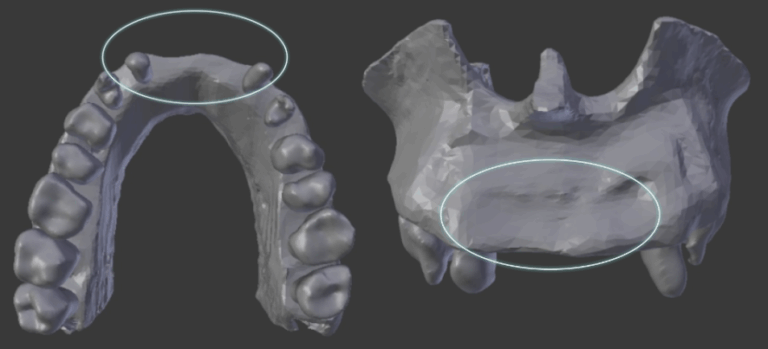
We’ve seen patients grafted with PRF who lost ridge height, making dental implants difficult or impossible without additional surgery.
This patient started with great bone support but was grafted with PRF.
Unfortunately, but not surprisingly, the PRF was unable to preserve the ridge.
She now needs expensive corrective procedures that could have been avoided.
So Why Do Dentists Still Use It?
But when the goal is to regrow bone, PRF just doesn’t do the job.
Final Takeaway
PRF may be great for soft tissue, but when it comes to bone regeneration, it’s not enough.
Now that you understand how bone heals, you can see it is obvious why concentrated platelet preparations provide no benefit for bone regeneration. Even though the contents of platelet preparations inhibit bone formation, they have no effect on bone formation itself because they are removed from the site long before bone cells arrive.
If your dentist is recommending PRF for bone healing, you should probably ask questions. There are materials available that do activate your body to grow true, healthy bone and not just cover the wound. You deserve to understand what’s going into your body, and whether it will actually help.
This blog post was summarized from an article intended for a professional audience of clinicians with a science and/or medical background. If you would like to further educate yourself with deeper material, read the original article here:

MEMBER:
American Society for Bone and Mineral Research (ASBMR)
Tissue Engineering and Regenerative Medicine International Society (TERMIS)
American Academy of Implant Dentistry (AAID)