
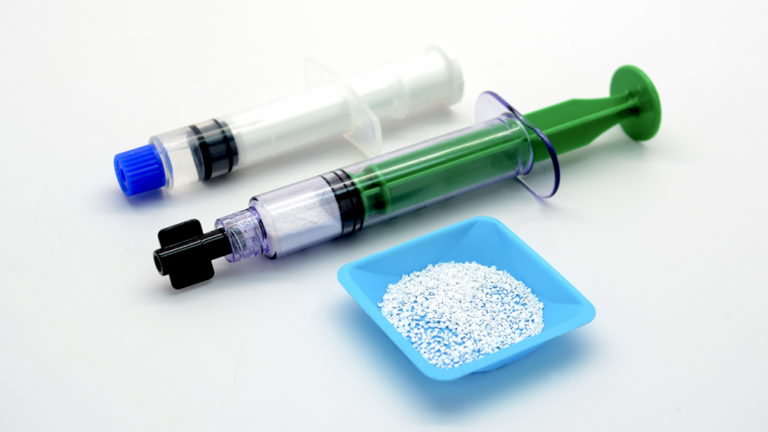
Ridge Graft Kit
- For use in ridge augmentations, periodontal lesions, and traditional lateral window sinus elevations
- Dual phase calcium phosphate based synthetic bone graft material
- Includes 3rd generation βTCP granules (500-1000μm)
Ridge Graft Kit
Ridge Graft Kit is a dual phase calcium phosphate biocement that comes in a set of two unmixed syringes and a packet of 3rd generation βTCP granules (500-1000 microns) which must be mixed chairside.
Ridge Graft Kit is easily mixed and shaped at chairside, and since it is not water soluble, it will not wash out during or after placement in the graft site.
This product should be stored in the refrigerator until use.
It is not recommended to mix Ridge Graft Kit with other materials.
Ridge Graft Kit contains no human or animal tissue.
Browse Our Use Cases
SL Factor
Ridge Graft Kit provides the organic and inorganic molecules a bone needs in order to regrow faster, stronger, healthier, and more vital.
Our patented SL Factor in our bone graft material targets the osteoblasts within the patient’s bone, initiating the bone regeneration process. Our product has been classified as a drug device and this the drug contained in this product has been shown to stimulate bone formation.
SteinerBio has the only bone grafts on the market that contain a drug that changes the physiology of a bone’s osteoblasts to stimulate osteogenesis. SL Factor, our patented organic compound, enters through the membrane of the osteoblasts and results in the following metabolic activities:
- SL Factor is absorbed by the osteoblasts
- SL Factor activates over 300 genes that stimulate the process of bone formation
- BMP2 and RUNX2 production increases two-fold and reduces osteoclast formation by inhibiting the production of RANK ligand
- Osteocalcin accumulation is enhanced in the extracellular matrix resulting in excellent mineralization
- While stored in the osteoblast, SL Factor continues to stimulate bone growth after the synthetic matrix has been resorbed
- Adipogenesis, osteoclastogenesis, and ODF/RANK ligand expression is inhibited
- Inflammation is reduced by inhibiting prostaglandin synthesis